
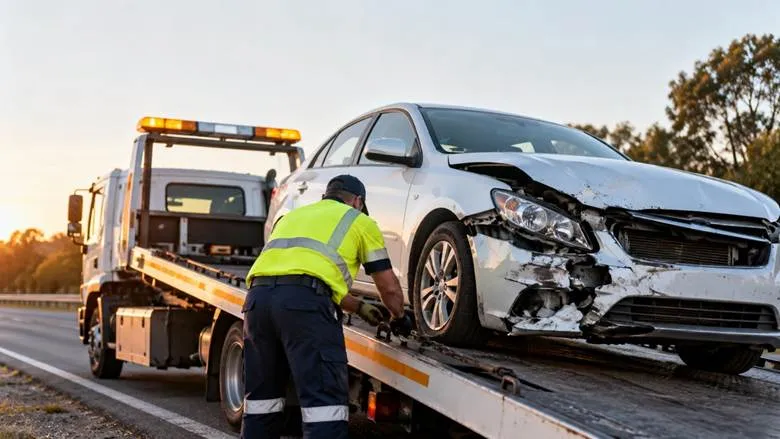
A car accident and a mechanical breakdown can leave you in the same situation: stranded on the roadside with a vehicle that cannot be driven. However, the towing process can be quite different depending on what caused the problem.
Accident towing often involves damaged vehicles, insurance claims and additional regulatory requirements. Breakdown towing generally involves mechanical or electrical problems that prevent a vehicle from operating safely.
Understanding these differences can help Australian drivers avoid unnecessary costs, make informed decisions and arrange the right assistance when something goes wrong.
What Is Accident Towing?
Accident towing involves recovering or transporting a vehicle that has been damaged in a collision and cannot be driven safely.
This may be necessary after a multi-vehicle crash, a collision with a roadside barrier, or an animal strike. Even relatively minor accidents can cause damage to steering, suspension, wheels or other components that make driving unsafe.
Unlike a routine breakdown, accident recovery may involve damaged bodywork, leaking fluids, debris or a vehicle positioned in a difficult location. The towing operator must consider these conditions before moving the vehicle.
For motorists across Canberra, Queanbeyan and Tasmania, Underground Towing & Salvage provides accident recovery and breakdown towing services, helping drivers arrange suitable vehicle transport when their cars cannot be driven safely.
Depending on the state or territory, accident towing may also involve specific authorisation procedures, licensed operators and regulated charges.
What Is Breakdown Towing?
Breakdown towing involves transporting a vehicle that has become inoperable due to a mechanical, electrical or other non-collision problem.
Common reasons include engine failure, overheating, transmission problems, battery or electrical faults, and tyre damage that cannot be repaired safely at the roadside.
Unlike accident towing, the vehicle may have no structural damage. The main concern is usually identifying whether it can be repaired on-site or needs transport to a mechanic.
For example, a flat battery may only require a jump-start, while a failed transmission will generally require professional towing.
Breakdown towing is often arranged through a roadside assistance provider, insurance-related service or towing company contacted directly by the driver.
Accident Towing vs Breakdown Towing: What Are the Main Differences?
Although both services involve moving vehicles, several practical differences affect how they are arranged.
|
Factor |
Accident Towing |
Breakdown Towing |
|
Cause |
Collision or impact damage |
Mechanical or electrical failure |
|
Vehicle condition |
May have structural or safety-related damage |
Often physically intact but inoperable |
|
Recovery requirements |
May require specialised handling |
Usually involves standard recovery, depending on the fault |
|
Insurance |
May be covered under comprehensive insurance |
May be covered by roadside assistance benefits |
|
Regulations |
Additional licensing or authorisation rules may apply |
Different regulatory requirements may apply |
|
Destination |
Repairer, insurer-approved facility or storage yard |
Mechanic, home or preferred destination |
|
Costs |
May include recovery, towing and storage |
Often depends on distance and recovery complexity |
An important distinction is that accident towing regulations are not identical across Australia.
For example, Transport Victoria distinguishes accident towing from trade towing, which includes breakdown recovery. Accident towing requires licensed vehicles and accredited operators, while trade towing operates under different requirements.
In New South Wales, drivers involved in accidents also have specific rights concerning towing authorisation, operator selection and vehicle destination.
Knowing the relevant rules helps drivers avoid confusion when arranging assistance.
What Should You Do Before Arranging a Tow?
The immediate steps depend on whether your vehicle has been involved in an accident or has stopped due to a mechanical problem.
After a Vehicle Accident
Safety should always come before arranging vehicle recovery.
-
Check for injuries. Call Triple Zero (000) if anyone is injured, trapped or facing an immediate emergency.
-
Secure the scene where safe. Switch off the engine, activate hazard lights and move away from traffic where possible.
-
Exchange relevant details. Record the other driver’s contact information, registration details and insurance information where applicable.
-
Document the damage. Take photographs of the vehicles and surrounding conditions if it is safe to do so.
-
Contact your insurer. Confirm whether accident towing is covered and whether a particular repairer or destination is required.
-
Understand the towing authorisation. Check the operator’s credentials, proposed destination and charges before signing any required documentation.
Reporting obligations vary by jurisdiction. In NSW, for example, a crash involving a vehicle that is towed away generally needs to be reported to police, even when officers do not attend the scene.
After a Vehicle Breakdown
When a vehicle develops a mechanical problem, the priority is to stop somewhere safe without creating additional danger.
Move away from traffic if the vehicle can still be driven safely, activate hazard lights and assess whether it is safe to remain inside.
On busy highways, avoid standing near moving traffic or attempting repairs in an exposed position.
Contact your roadside assistance provider if you have coverage. Some problems, such as a flat battery, may be resolved without transporting the vehicle.
If towing is necessary, explain the symptoms, vehicle type, exact location and intended destination to the towing operator.
Who Pays for Accident Towing and Breakdown Towing?
The cost of towing depends on the circumstances, insurance arrangements, location and type of recovery required.
Accident Towing Costs
Comprehensive car insurance may cover reasonable accident-related towing expenses, subject to policy conditions.
However, coverage is not automatic. Drivers should confirm whether their insurer will arrange towing, reimburse expenses or require the vehicle to be transported to an approved facility.
Some Australian jurisdictions regulate certain accident towing charges. For example, NSW sets maximum charges for specified towing services, while metropolitan Melbourne has regulated accident towing rates.
Additional costs may arise from specialised recovery work, extended transport or vehicle storage.
Breakdown Towing Costs
Breakdown towing is commonly covered under roadside assistance memberships, although distance limits and service exclusions may apply.
Drivers without coverage generally pay the towing provider directly.
The final price may depend on travel distance, vehicle size, accessibility, time of service and whether specialised equipment is required.
Before confirming a booking, ask about the total expected cost, included distance and potential additional charges.
Why Does Choosing the Right Towing Operator Matter?
Not every towing situation requires the same equipment or recovery approach.
A vehicle with a mechanical failure may be straightforward to load onto a flatbed truck. However, a collision-damaged car with locked wheels, broken suspension or significant body damage may require additional precautions.
Choosing an operator with suitable equipment and experience can reduce the risk of further damage during loading, transport and unloading.
According to Joshua Harrison, Founder of Underground Towing & Salvage, a vehicle that still starts after a collision is not necessarily safe to drive. Drawing on his experience with accident recovery, Harrison has highlighted how animal strikes can damage components around the cooling system, steering and wheels without the full extent being immediately obvious. His advice is to arrange recovery when there is uncertainty about the vehicle’s condition rather than risk driving it and discovering a more serious problem on the road.
With more than 11 years of towing and recovery experience through its founder, Underground Towing & Salvage handles both routine breakdowns and more complex vehicle recoveries. Its range of work includes accident-damaged vehicles, restricted-access locations and underground car parks requiring specialised towing equipment.
For drivers, the practical lesson is to provide accurate information about the vehicle’s condition before requesting assistance. Mentioning damaged wheels, fluid leaks, restricted access or unusual vehicle positioning helps the operator determine what equipment may be needed.
Clear communication also helps establish the intended destination, expected charges and recovery arrangements before the truck arrives.
Final Thoughts
Accident towing and breakdown towing serve the same basic purpose, but the circumstances surrounding each service can be very different.
Accident towing may involve damaged vehicles, insurance claims, special recovery procedures and additional regulatory requirements. Breakdown towing generally focuses on mechanical failures and transporting vehicles to a suitable repair location.
For Australian drivers, the most important steps are to prioritise safety, understand their insurance or roadside assistance coverage, confirm towing costs and communicate clearly with the operator.
Knowing what to expect before a roadside emergency can make an already stressful situation easier to manage and help ensure the vehicle receives the appropriate assistance.