
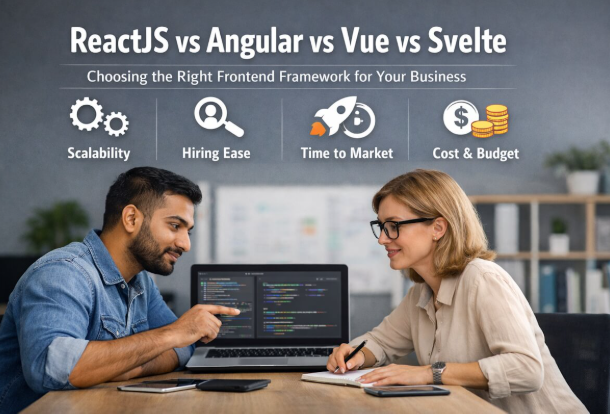
Choosing a frontend framework is not just a technical decision. It is a business move.
The framework you pick shapes how your product feels, how fast your team builds, and how easily you scale later. It affects hiring. It affects cost. It even affects how quickly you can react to market changes.
ReactJS, Angular, Vue, Svelte. They all promise modern web development. Clean UI. Fast performance. Easy maintenance.
But which one actually fits your business?
Let’s break this down in simple terms. No overcomplicated explanations. Just practical insight that helps you decide.
Why Frontend Technology Matters to Your Business
Your frontend is the face of your product. It is what customers click, scroll, tap, and judge.
If it feels slow, confusing, or clunky, users leave. They do not care about the framework name. They care about experience.
At the same time, your internal team cares about structure, code management, hiring availability, and long term sustainability.
So the decision must balance two things.
User experience and business scalability.
That is where ReactJS often enters the conversation.
Understanding ReactJS from a Business Perspective
ReactJS is a JavaScript library created by Facebook. It focuses on building user interfaces using reusable components.
Instead of writing large blocks of code for entire pages, developers break the interface into smaller pieces. Each piece works independently and can be reused across the application.
For your business, this means faster feature development. It also means easier updates later.
Need to change one section of your dashboard? You can update that specific component without touching the entire system.
React also uses a virtual DOM, which helps update only the parts of the page that change. In real terms, your application feels faster and smoother, especially when dealing with complex user interactions.
This is why many companies look for ReactJS Development Services in India when building scalable platforms. They want structured yet flexible solutions without overcomplicating the tech stack.
But React is not the only option.
Let’s compare it with other popular frameworks.
ReactJS vs Angular: Flexibility vs Structure
Angular is a full framework backed by Google. Unlike React, it provides a complete setup from day one.
Routing, form handling, HTTP services, state management. Everything comes built in.
For large enterprises with strict development standards, this can be appealing. It enforces consistency. It reduces architectural debates. Teams follow defined patterns.
But that structure can feel heavy.
Angular has a steeper learning curve. Development may take longer initially. The framework is opinionated, which means less freedom in how you build.
React, on the other hand, gives you flexibility. You pick the tools you need. You design your own architecture.
If your business moves fast and needs to pivot quickly, that flexibility matters.
So ask yourself.
Do you want a predefined system or customizable building blocks?
ReactJS vs Vue: Simplicity vs Ecosystem Size
Vue is known for its simplicity. Many developers find it easier to learn compared to React or Angular.
For small to mid sized projects, Vue works well. It offers reactive data binding and a clean structure without overwhelming complexity.
But when you think long term, ecosystem size becomes important.
React has a massive global community. More third party libraries. More tools. More hiring options.
Vue has strong support too, but the talent pool is smaller, especially in the US market.
If your business plans to scale aggressively, you need access to developers without struggling to find them. That is one reason companies prefer to Hire React Developers instead of limiting themselves to smaller ecosystems.
Hiring flexibility gives you breathing room.
ReactJS vs Svelte: New Approach vs Proven Stability
Svelte takes a different approach. Instead of relying heavily on runtime processing, it compiles code during build time.
This can result in smaller bundle sizes and impressive performance.
Sounds attractive.
But Svelte is still newer compared to React, Angular, and Vue. The ecosystem is growing, but it is not as mature.
Fewer enterprise level tools. Fewer experienced developers available for hire.
If you are building an experimental product or a lightweight application, Svelte might be interesting.
If you are building a large SaaS platform expected to scale for years, React offers more stability and long term predictability.
Sometimes stability is more valuable than novelty.
Key Business Factors to Consider Before Choosing
Instead of focusing only on technical features, consider these practical questions.
Hiring Availability
Can you easily hire developers for the framework?
React clearly leads in terms of global adoption. The developer community is large across the US, Europe, and Asia.
If you plan to expand your engineering team quickly, React reduces hiring pressure.
Choosing a niche framework may limit your recruitment options.
Time to Market
If speed is critical, React allows you to start small and expand later. Its modular structure helps teams build features quickly.
Angular may require more upfront setup.
Vue offers simplicity for faster onboarding, especially for smaller teams.
Your timeline matters. Are you launching an MVP or building an enterprise grade internal system?
Long Term Maintenance
Applications rarely stay static. Features evolve. Markets shift. User expectations change.
React’s component based approach makes maintenance manageable. You can isolate updates without rewriting entire sections.
A framework with strong community backing also reduces the risk of long term abandonment.
You do not want to rebuild your frontend in three years because the ecosystem shrank.
Scalability
Scalability is not just about traffic. It is about team growth.
As your company grows, can your frontend architecture support multiple developers working simultaneously?
React’s modular structure supports parallel development. Teams can work on separate components without stepping on each other’s toes.
That matters when deadlines tighten.
Cost Implications for Businesses
Framework decisions influence cost in ways many businesses overlook.
Hiring costs vary based on developer availability. React’s popularity often keeps market rates competitive due to high supply.
Training costs matter too. If your team already has React experience, switching to another framework increases onboarding time.
Maintenance costs also depend on ecosystem maturity. More libraries and tools often mean faster problem solving.
Businesses that choose React often partner with offshore teams offering ReactJS Development Services in India to balance expertise with cost control.
It becomes a strategic decision, not just a technical one.
When ReactJS Makes the Most Sense
React tends to be a strong fit if:
You are building a SaaS platform.
You need dynamic dashboards or real time features.
You expect frequent product updates.
You plan to scale your engineering team.
You want flexibility in architecture decisions.
React supports both startups and enterprises. The difference lies in how you structure the project.
Its flexibility allows you to grow without feeling boxed in.
When Another Framework Might Be Better
Angular may be suitable for large enterprises that prefer strict guidelines and standardized workflows.
Vue works well for smaller projects where simplicity is the priority.
Svelte may fit performance focused experimental builds.
There is no universal winner.
The right choice depends on your business goals, internal capabilities, and growth expectations.
The Hiring Strategy Angle
Let’s be direct.
Technology decisions affect hiring pipelines.
If you choose a widely adopted framework like React, you open access to a larger global talent pool. That makes scaling smoother.
When companies decide to Hire React Developers, they gain access to experienced engineers across multiple regions.
If your business grows faster than expected, you can expand your team without scrambling for rare skill sets.
That flexibility reduces risk.
Performance: Real Impact vs Perception
All modern frameworks deliver solid performance when built correctly.
Performance differences often come down to architecture and developer expertise rather than the framework itself.
React’s virtual DOM helps manage updates efficiently.
Angular handles complex enterprise systems with built in tooling.
Vue offers reactive updates with a straightforward structure.
But no framework fixes poor planning.
The quality of your development partner matters just as much as the technology.
Looking Beyond Trends
Technology trends change quickly. Business fundamentals do not.
You need a framework that supports your roadmap, hiring plans, and budget constraints.
React remains popular not because it is trendy, but because it balances flexibility, community support, and scalability.
That combination reduces business risk.
So instead of chasing hype, evaluate your priorities.
What are you building?
How fast do you need to release?
How large will your team become in two years?
What level of control do you want over your architecture?
Answer those honestly.
The decision becomes clearer.
Making the Call That Supports Growth
Frontend frameworks are tools. Your strategy determines how useful they become.
If your focus is scalability, hiring flexibility, and long term support, React often stands out as a strong choice.
If structure and strict conventions matter more, Angular might serve you better.
If simplicity is your top concern, Vue may be appealing.
The key is alignment. Not popularity.
For many growing businesses, exploring ReactJS Development Services in India or deciding to Hire React Developers becomes a logical step toward building scalable web applications without limiting future growth.
Your framework choice will shape your product’s future. Make it a decision based on business logic, not noise.
Choose what supports your growth plan.
Everything else is secondary.